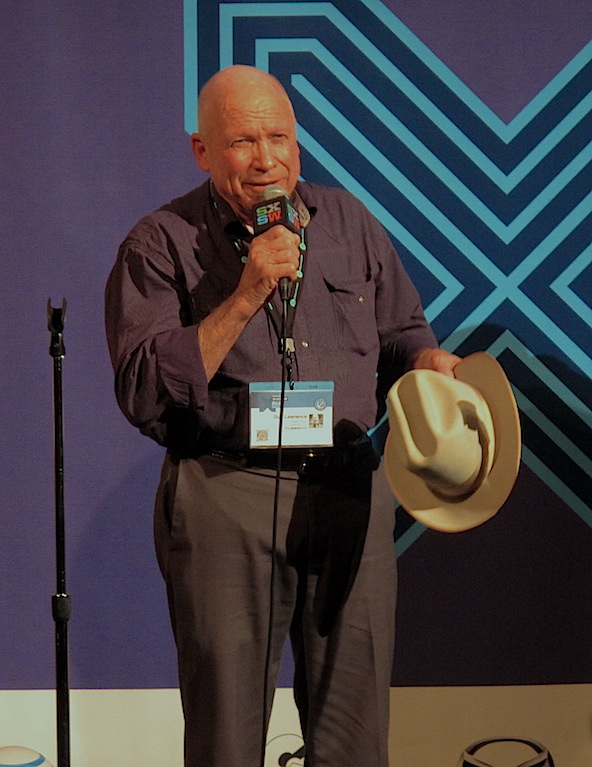
Peace Officer is the story of Dub Lawrence. Presently a retired sheriff in a small town in Utah, Dub was elected in the 1970’s, at a time where SWAT teams were all the rage and local communities, following the example of Los Angeles, were allocating budget to train their men and provide them with gear. Thirty years later, the war on drugs and then the war on terror have created a climate of angst and violence. The very SWAT team that Dub helped found is called to a scene at Dub’s daughter’s house. After hours of negotiation, Dub’s son-in-law is killed, and Dub goes back to what he knows how to do: investigating and seeking fairness.
The documentary touches to the problem of the militarization of the police, an issue that was raised during the events of Ferguson last summer. Though it focuses solely on Utah, the situation is likely the same in other cities and states: the bill that lets the US Army donate used military gear to local state police comes with a provision mandating the use of said gear in the field within the first year. Violence has become a state of mind, ingrained in the culture of states and cities law enforcement agencies.
Dub is contacted by several other families whose house was stormed and, in each case, finds troubling evidence that not only are SWAT teams essentially seeking to execute their targets rather than serving a search warrant, but the forensics conducted at the crime scene do not actually line up with the recounting of the raid by the agents.
This might be pushing the envelope but what struck me is the similarity of Dub’s initiative with that of Edward Snowden. Their actions are radically different in terms of scope and impact. But at core, they do share a lot: one person working for the government, coming from a family of civil servants, in a position to serve their community and ultimately deciding to take a stance against what they perceive as an obvious violation of the rights of the people. One is fighting a state of massive surveillance while the other is fighting a state of pervasive violence.
In both cases, observing the reaction and justifications of the elected officials is key – how justice is served is another interesting aspect of both stories. The most striking quote for me comes from a high-ranking police official in Utah:
The police can be perfectly justified to to kill an innocent person
That about sums it all. Peace Officer won the documentary grand jury prize at SXSW.
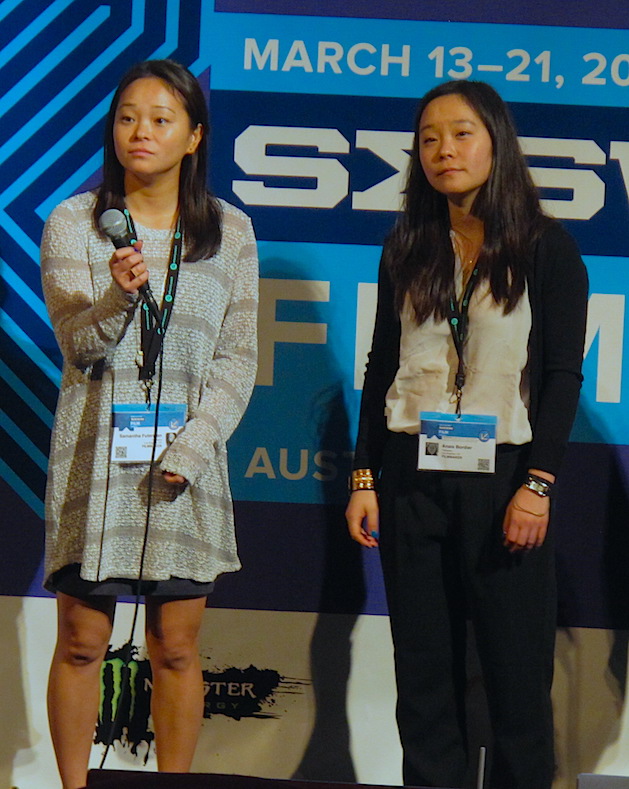
Twinsters is the rather incredible story of two Korean-born twin sisters, adopted by different families and raised on different continents, finding each other 25 years after their birth. After watching a YouTube video in which one of them is performing, a friend shares the link on Facebook and passes it along, pointing out the incredible physical ressemblance of the two.
Facebook happens and as the discussion unfolds, both women realize they are born on the same day in the same hospital. One (Sam) was adopted by an American family and eventually moved to Hollywood to be an actress. The other (Anais) is an aspiring London-based fashion designer raised in France. Neither of their birth certificates make mention of a sibling. Neither of their adoptive families has been told about this, nor had their Korean foster parents.
This is a story of discovery, an incredibly emotional one – I could have sworn someone was cutting onions in front of my very seat for the first 25 minutes of the movie. Both of them, both of their families and all of their close friends suddenly having to find a way to connect with strangers. Having to travel around the world to see each other, in London first then in California, finding comfort in bringing people with them while also seeking to spend time alone to connect with each other.
As someone who was born and raised in France and who has been living in California for close to 8 years, I could sense how beyond their obvious personal connections as sisters, the two were reacting differently to the situation because of their education and background. At some point in the movie, Anais is confronted to a proposition to go to Korea and not only investigate how the twins were separated at birth but also just to meet her foster mother for the first time – something Sam had done the year before.
Possibly because of her personality and of her only-child background, Anais seemed to be wanting to fit in and go about her life without spending time or energy trying to find out where she was born – it’s a perfectly valid accepting stance, and I could sort of tell it also relates, culturally, to her being raised in France. We’re taught to be discreet, to not cause a fuss and to control our emotions. On the other hand, Sam is a lot more proactive, but also looks to be more vulnerable and emotional – she hides less of herself and looks to be more welcoming of her feelings, which is something I think is true of a lot of people raised in America.
In any case, this story (I wouldn’t call it a documentary per-se) is incredibly powerful and well worth watching.
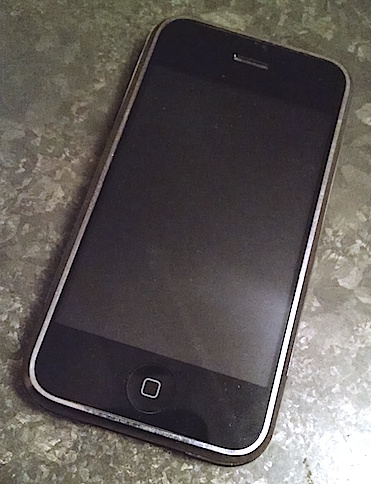
I was recently doing some spring cleaning around my apartment and randomly dug up my old first-generation iPhone. I bought a 8GB model (top-of-the-line back then) on the day after I moved to the Bay Area, sometime in September 2007. The activation process and the requirement to use iTunes was already a pain in the butt at the time: I remember having to cheat with the AT&T rep because I didn’t yet have a social security number – I ultimately managed to find a page on some obscure Internet forum that listed the SSN AT&T used for testing purposes.
I managed to get hold of a old-school dock cable and connected it to my computer. To my surprise, the phone’s screen turned on and displayed the familiar charging battery icon. Thankfully, iTunes decided to leave the phone alone. I let the phone charge for a couple of hours but couldn’t get it to turn it on after that. The top button must have been damaged at some point and I had to ‘force touch’ it in every possible way before the phone finally greeted me with the familiar chromed Apple logo.
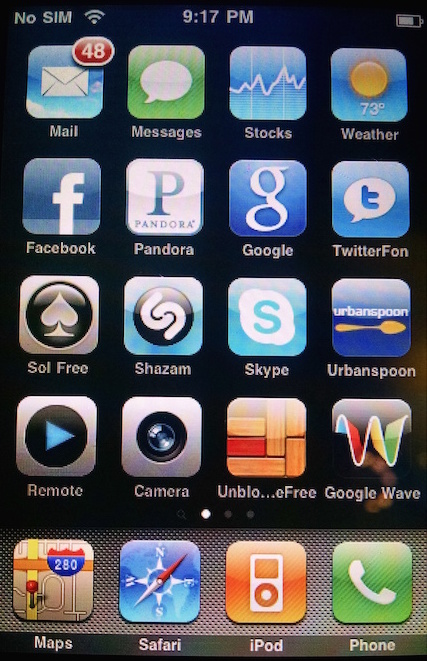
Yes, that's a Google Wave app
Turning on an old digital device feels like unearthing a forgotten time capsule, even more so when it’s something as personal as a smartphone. My lock screen shows an adorable picture of my now 10-year old nephew when he was probably just 4 or 5. The music library feels strangely familiar and vintage at the same time - I miss the newer stuff that now lives in my online locker, but there are tunes that I had forgotten even existed. In the absence of a network connection, pretty much all the apps display data which is cached and has become like frozen in time: stock quotes, texts, tweets, notes and emails are there waiting for someone to find out and make sense of.
R.I.P. JAVA ticker
Some time in December 2009, the AAPL stock was priced at $193.34 – a considerably higher price than today’s ~$125 if you forget to account for the 7-to-1 split that occurred just a few months ago.
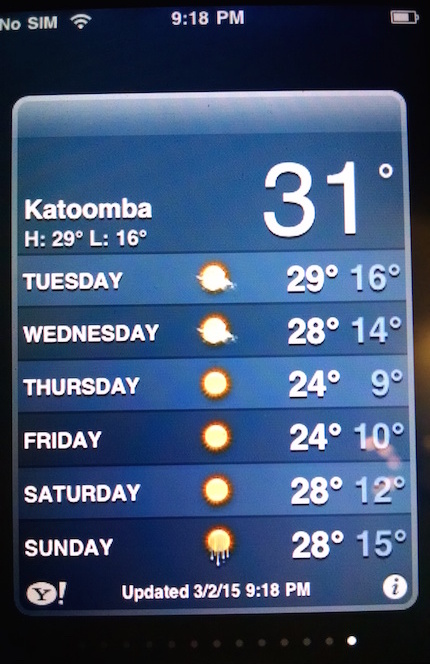
Holly Molly Celsius degrees
Despite its old age, the battery lasts for quite a long time. Left unused and in the absence of cell reception (the original SIM card is AWOL), it looks like it would hold a single charge for weeks. The phone feels decently fast – while it definitely isn’t on par with a flagship iOS or Android device sold today, the overall performance is honorable and all apps that are installed on it run ‘smoothly’, for some value of smoothly.
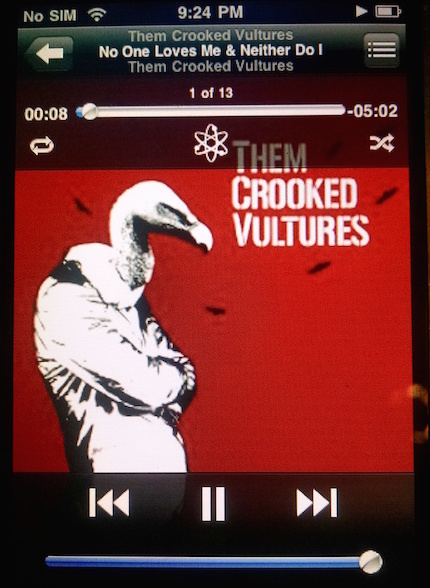
You keep using this word, 'Supergroup'
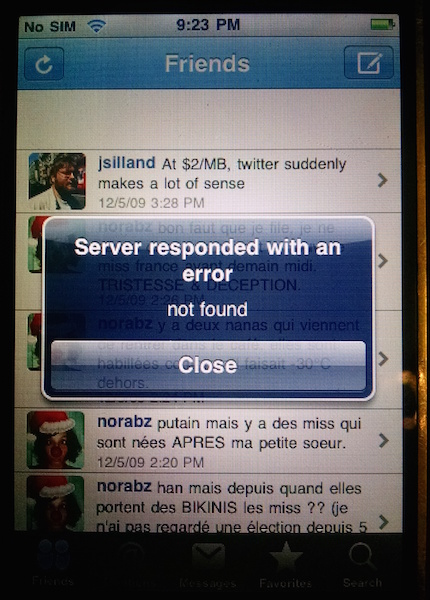
Speaking of which, let’s look at the software. Right there on the home screen, three service apps that haven’t died since that phone went unused (which was circa late 2009): Facebook, Skype and a Twitter client. I don’t know whether an official Twitter client existed at the time but regardless: this is a testimony to Twitter’s change of policy vis-a-vis their developer community. And the results are: Facebook crashes on startup, TwitterFon errors out and Skype silently fails to connect. In the last two cases, some old contact and tweet data was still cached and shown:
Not a fail whale, but not a happy bird either
Remarkably, some other apps that do rely on online services work just as well as they used to. In particular, data-heavy Google Maps and Google Earth keep on chugging map tiles along. Seeing the Earth rotate in 3D and zooming in to my neighborhood to see up-to-date map data is always impressive, but it is even more so on a device which has long been EOL’d. YouTube browsing and playback still works as well, and so do more minor apps such as the Stocks and Weather ones (these are backed by Yahoo APIs).
YouTube still chugging along. Rose McGowan, not for much longer… ♫ Hang up the chick habit ♫
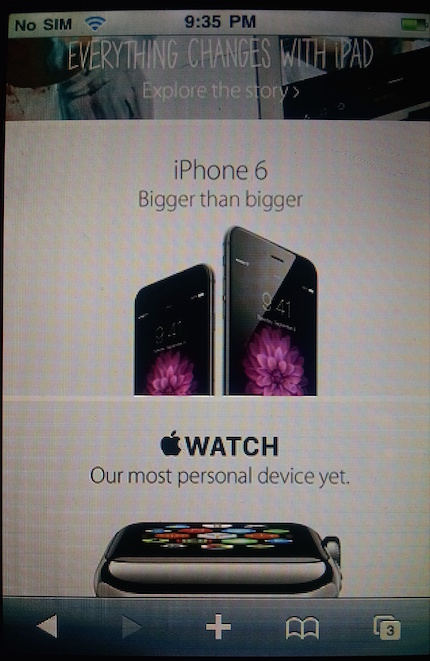
On the front of Apple-provided applications, Mail works, even though I had to update its configuration to an app-specific password because of Google’s 2-factor auth. Safari also manages to properly render many of the websites I threw at it, albeit rather slowly. This included the responsive version of the Apple homepage which currently features the Apple Watch.
It probably took less time to write that responsive CSS file than it took for Safari to parse it, which says a lot
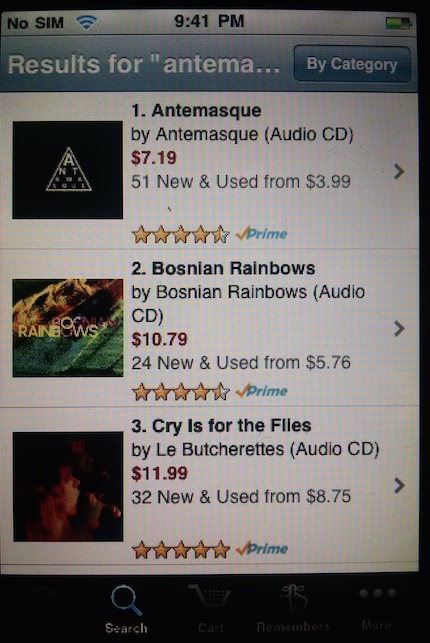
The Amazon app also worked well – I didn’t try to purchase anything but the searching and browsing experience worked well enough:
If you told me in 2009 that I would be purchasing vinyls in 2015
From a design standpoint, the device itself actually feels remarkably good. For sure, it is a bit heavy, a bit small and a bit thick but the brushed aluminium and glossy screen combo gives the impression to hold something precious and solid. This alone is a truly remarkable sign of a product that was at the forefront of the smartphone revolution. Things are not as bright from a UI standpoint and its easy to observe how the years have taken a toll – this phone was designed at a time we didn’t even know skeuomorphism was a problem.
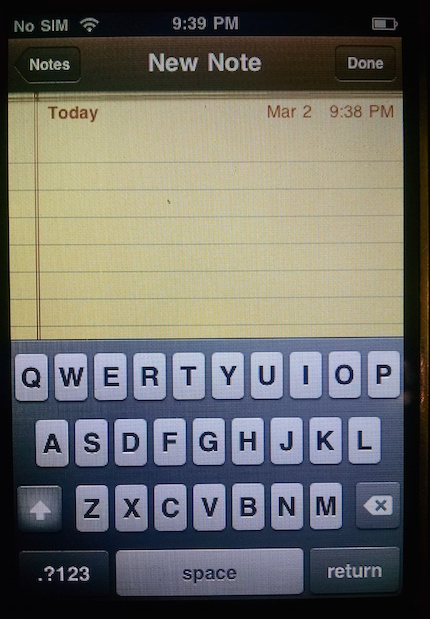
Learn this old weird trick to make Jony Ive sad
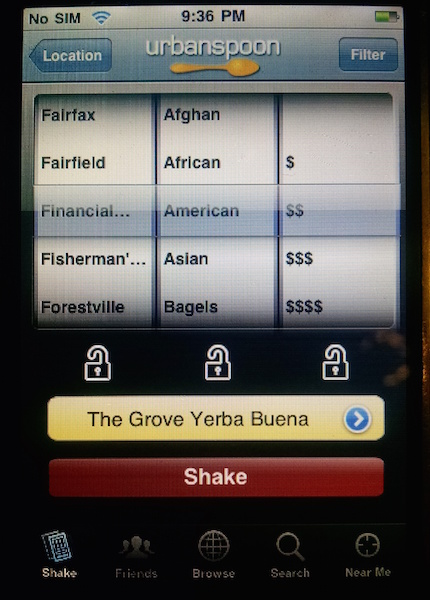
Buttons, menu, keys – everything in the UI layer has depth, a color gradient – so far away from today’s flatitude. But as it turns out, the navigation patterns are essentially similar to that of today’s iOS 8 – a single button only goes so far and that’s something that definitely didn’t change between then and now. Conceptually, some applications are stark reminders of how services lacked back then. If I wanted to find a restaurant today, I’d ask Google Now or Siri to find one for me, which would then point me to reviews and let me book through Opentable. Back then, Urbanspoon was all the rage: shake your phone and let chance pick for you. I certainly had a blast using that app but I don’t think I would rely on it again.
After Russian roulette but before Chatroulette, there was restaurant roulette
Conversely, the iPhone also lacked features that are pervasive in today’s phones. GPS is an example – my own company’s product assumes people have a GPS-enabled device, in most cases a phone. But the iPhone 1 had no GPS chip and provided no location services. Only after third party apps started providing cell-tower-based triangulation did Apple work on building the same feature in Google Maps. And even then, the results were approximative. From a software standpoint, the lack of gestures and swype-like keyboard make typing a fairly painful task.
It turns out that the iPhone was such a groundbreaking device at the time that what it brought to the table still ripples through today’s mobile computing. Every other phone that came after it essentially built upon the foundation that the iPhone 1 laid out. Screens are sharper and bigger but the form factor is essentially similar between the iPhone 1 and the Nexus 6. Functionalities have evolved ; smarter services like Google Now and Siri have turned reactive devices into true personal digital assistants. Ultimately, software is the greatest differentiator but as Alan Kay once said:
People who are really serious about software should make their own hardware
That’s a recipe Apple has mastered and applied time and time over - something to remember in those wearable days. Visually, it’s easy to look at something the from the past and to observe glaring issues with it – in hindsight, 20/20. But the truth is that the first iPhone remains essentially usable (if not useful) 8 years after it was released and well over 10 years after the product research and prototyping started. It’s a true testimony to Apple’s build quality and the talent of its mobile R&D team.
Last week, Bloomberg ran a story about Julissa Arce, who became a vice-president at Goldman Sachs in 2011 at the age of 28, after having spent most of her life in the US as an undocumented immigrant. At age 11, her and her family moved from Mexico to San Antonio, Texas. She went on to become a top-student at her school and was allowed to attend college after the law stopped requiring educational institutions from asserting the legal status of their students. She majored in finance and joined Goldman Sachs after a summer internship in 2004:
Arce hadn’t seen many Hispanic men wearing business suits before joining the club, and she still does a Hollywood swoon when she describes them. Meetings with successful women were just as important. “I could be ambitious and go-getter without seeming greedy and aggressive,” she says. “There are all these amazing jobs, and there’s all this money to be made.” When the group handed out awards one April, it named her its Future Millionaire.
Arce’s story is strikingly similar to that of Jose Antonio Vargas, a Pullitzer-winning journalist who was born in the Philippines and was sent by his mother to live in the Bay Area at the age of 12. In 2011, he publicly came out as undocumented in an incredibly moving piece published in the New-York Times. Just like Arce, Vargas thrived in school and his writing landed him a job at the Washington Post – they both shared the idea that hard work would bring them recognition or wealth and ultimately earn them the right to remain in the country they called home. And just like Arce, Vargas' story is that of a heartbreaking rupture. Lacking the paperwork to cross the border means they cannot visit their relatives:
It’s been almost 18 years since I’ve seen my mother. Early on, I was mad at her for putting me in this position, and then mad at myself for being angry and ungrateful. By the time I got to college, we rarely spoke by phone. It became too painful; after a while it was easier to just send money to help support her and my two half-siblings. My sister, almost 2 years old when I left, is almost 20 now. I’ve never met my 14-year-old brother. I would love to see them.
Though unlike Arce, Vargas' path to permanent residency was once obstructed by the fact that he is gay:
Lolo kicked me out of the house for a few weeks. Though we eventually reconciled, I had disappointed him on two fronts. First, as a Catholic, he considered homosexuality a sin and was embarrassed about having “ang apo na bakla” (“a grandson who is gay”). Even worse, I was making matters more difficult for myself, he said. I needed to marry an American woman in order to gain a green card.
Ironically enough, Arce is quoted saying she once considered marrying a gay US citizen as a mean to obtain residency. As of today, Vargas is still in a legal no man’s land – no one being quite able to determine whether he is entitled to stay in the US. Two powerful demonstrations of how the immigration system is broken and senseless.
A little while ago, I walked in to my favorite neighborhood bakery and took notice of the t-shirt of the employees was wearing: a simple white on black ‘Die Techie Scum’. I found it mildly disturbing, and my first reflex was to make a comment to that effect. Luckily, I heard my remark in my brain before it went out my mouth, which in turn triggered me to shut the hell up and instead wonder why I felt that way.
A friend jokingly suggested I shouldn’t have left a tip that day. Because as a wealthy individual, that should be the way you communicate your discontent with the opinions of someone making less money than you do. Not.
I, unavoidably and unwillingly, identify as a techie: white, male, upper middle class, SF transplant, graduate in CS and working as an engineer at a top tech company. I was part of the second batch, the one from 2007. I moved to my first apartment in San Francisco because the shuttles allowed me to. Like the eternal September or yore, the three years after the Google IPO marked the beginning of an influx that was only slightly slowed down by the recession.
These days, the valley regales itself week after week of news stories of how Uber threatens journalists and of how Twitter fails to handle the abuse and harassment happening on their network. The language and actions of disruption have become stronger – ads for Prius-leasing companies targeting Lyft drivers are popping up on the web. VC money keeps pouring in, sometimes financing the most absurd projects.
And despite the obvious escalation, the Chronicle published a piece positing that the anti-tech movement has become irrelevant. I think it nails it when even one of the protesters against this year’s Crunchies is quoted speaking against the personal turn that the protests seemed to have taken:
Outside the Crunchies, Marc Bruno, a longtime North Beach activist who ran against current Assemblyman David Chiu for supervisor in 2012, said the antitech movement fell short in part because it failed to win enough potential allies. Tech workers, like the ones he often sees helping feed the hungry at church dinners, could have rallied against industry excess and income inequality, he said. Instead, protests felt like an indictment of techies themselves, hindering the movement.
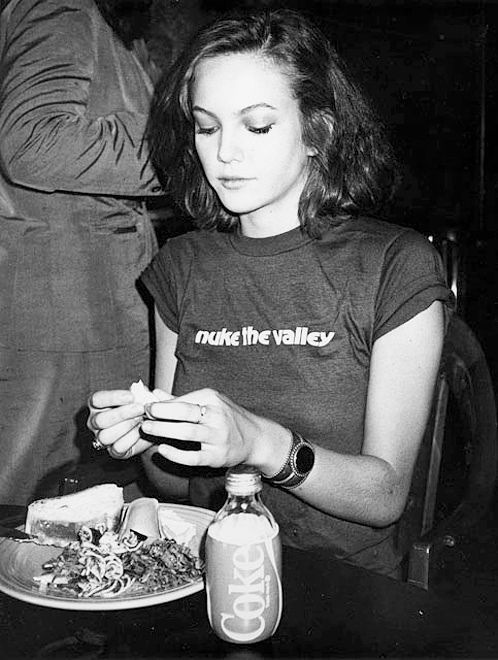
I never really had any hope that protesting Google shuttles would ever stop the new fangled shiny condo buildings from mushrooming around mid-Market. Getting tech companies to pay up for the use of Muni stops only went so far. Techies are not going away – there’s no other place for them to get jobs. So, as far as t-shirts go, I much prefer the one worn by Diane Lane when she was shot by Andy Warhol:
She, of course, meant the San Fernando valley. Times have changed.
You read it here first! Two days ago, Facebook unveiled the Android and iOS ports of their React framework, targeting native platforms using Javascript as a source language:
Joking aside, it looks like React Native has been in the works for a while and I don’t think my line of reasoning was particularly insightful. But I do think it is nice to see Javascript become a prime language for mobile applications and I think Facebook will be quickly followed at least by Google.
I also very much like that the Facebook engineering team isn’t setting cross-platform compatibility as a goal of the React project – as mentioned in the first part of the keynote, React is more concerned with promoting programming practices rather than with providing a full-blown multi-platform compatibility layer. ‘Write once, Run anywhere’ becomes ‘Learn once, Write anywhere’.
In any case, between Twitter’s Fabric, Facebook’s React and Google’s Polymer, the number of options to work with is growing, which is a Good Thing™ for developers, for the industry and ultimately for the users. Let’s hope it keeps Microsoft and Apple on the tip of their toes.
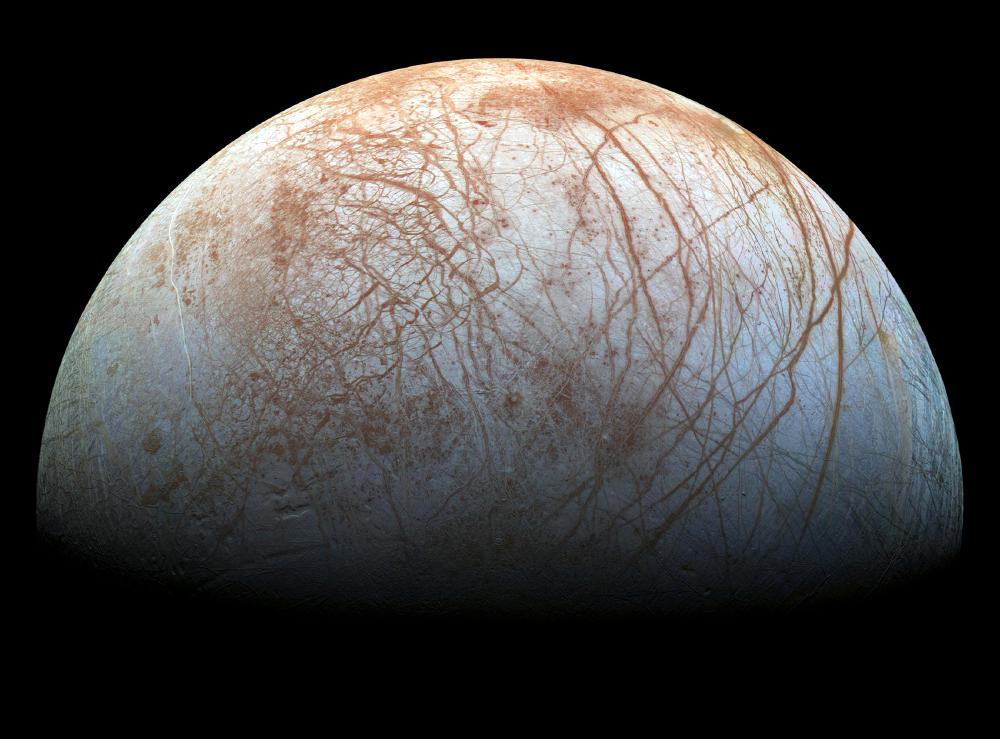
I’m a sucker for good astronomical pictures and NASA recently released a stunning new high definition picture of Jupiter’s moon Europa. What’s always surprised me about the solar system is the variety of worlds it contains. Even when bodies are roughly in the same locality like the Jovian moons, it’s as if the slighest change in position or inital composition has the potential to yield wildly different results.
Europa is of particular interest since it is a prime candidate for being amenable hosting life. The liquid ocean lying under its frozen surface might be heated by the volcanic activity resulting from Jupiter’s massive tidal forces. There might be an entire ecosystem thriving in the dark depths of a tiny moon orbiting 600 milion of kilometers away.
I’ve been geeking out a bit about Europa and found a Wikipedia list of the geological features identified on Europa. As was done for our Moon, scientists and geologists have named the various ridges, mountains and regions of Jupiter’s satellite.
I really wonder how they came up with and agreed upon the nomenclature but there are two general themes. The first is names appearing in ancient greek mythology and in particular those related to Europa the character. The other theme is that of celtic mythology: Annwn Regio, Murias Chaos, Amergin Crater … I’d be curious to find out how that came out to be. But it’s a pleasant thought that people in astronomy labs are giving a damn about this and refer to a physical location as ‘Castalia Macula’ rather than just ‘that dark spot up there’.
We’ll have to settle for robots for another while, but I can’t wait for the day a human sets foot on Narbeth Chaos.