75 years of Batman

Of the all the major superheroes, Batman has always held a place near and dear to my heart. Tim Burton’s 1989 movie and its gothic aesthetics were the first contact I had with Batman’s character and I’ve never fallen out of love, except maybe with the comically bad Batman & Robin.

In Batman lies the idea that humans ultimately have their destiny in control, if only partially. We are each responsible for how we respond to the events in our lives and how our response shapes our environment. Batman has no super powers – just the drive and the means to achieve the mission he set for himself. More importantly to his character, Batman’s entire reason to exist is for him to stop existing: he seeks to construct a future where Gotham is no longer in need of Batman.

Shopping for graphic novels is one of the rare things that is incommensurably better in France than it is the U.S. Despite North America being the birthplace of the modern comic-book, there is a much stronger culture and acceptance of graphic novels as a way to tell a story on the other side of the pond. Brick and mortar stores are manifold and the selection is richer.
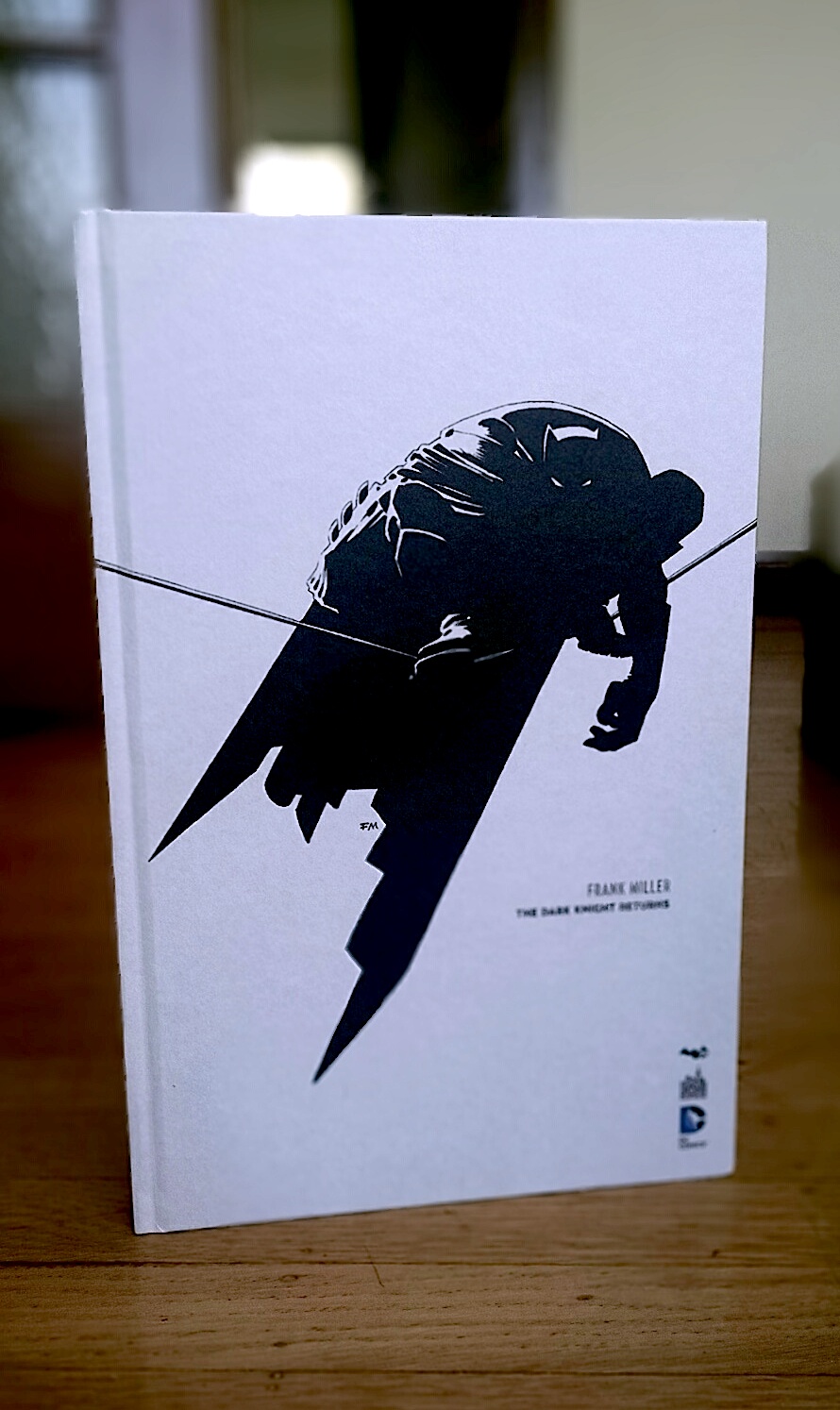
Batman 75 years – Volume 2

In honor of Batman’s 75th anniversary this year, French publisher Urban Comics has released a series of five deluxe hardcover volumes, in black and white. These stories have been published before but I am surprised that I couldn’t find the equivalent edition of those books in English. In any case, I have ordered all five and can say they belong to the collection of any self-respecting Batman fan, even in the French language. The series gathers the works of Frank Miller, David Mazzuchelli, Jeff Loeb, Scott Snyder, Greg Capullo… Or, as the French would say, la creme de la creme.
Citizen Four

Citizen Four is the codename Edward Snowden was using to sign the first set of emails he sent to Laura Poitras, and it’s also the title Poitras has chosen for the movie she has been producing about their encounter. The central piece of the documentary is a week-long interview with Glen Greenwald in a hotel room in Hong-Kong.

Throughout his interview, Snowden is determined and calm, very well-spoken, clear-minded and level-headed. He knows the topic he’s talking about inside and out and is keen on fully answering the questions asked by Greenwald and going forward with the publishing of the documents he took from the NSA.

He is conscious that the spin doctors in DC are going to try to target him personally, and explains this is why he wants to remove his own bias by using the press as a proxy – from what is shown in the movie, it’s a working relationship. He doesn’t talk much about himself, not because he has something to hide but because he feels it would be a distraction to the people, something the government could exploit.

The aesthetic of the film is that of a quiet, international espionage thriller where a lot is playing out behind the scenes. Did he just walk out of the hotel and into a cab at the time his face was on every screen in the world? Where was he hosted after that? The whole episode of the Moscow airport, including how specifically WikiLeaks provided assistance, remains shrouded in mystery.

On a couple of occasions, the documentary deliberately goes for the comical effect. Snowden not only mentions the ways in which intelligence agencies are spying, he lives by them. In front of two incredulous journalists, he is seen covering his head and laptop under a blanket before typing a password. Later in the film, lawyers representing him not only turn off their phones, but the phones are taken out of the room before the meeting can begin.

Snowden’s background, that of a kid raised in military family, only reinforces the sentiment that he’s genuinely chose to join the NSA and then to out its practices to not just make rent or for fame, but because he genuinely believes that the government is acting against the interest of the people.

The only moment of perceivable weakness is when Snowden is shown chatting with his girlfriend, who he had left entirely in the dark as to his intentions. Well over a year after the first NSA documents were first published in the Guardian, this movie is less about the repeated lies of the US government and the intelligence community and presents the flip of the coin. It isn’t a portrait of Edward Snowden, but it’s the most personal it’s going to get.

France doesn't call ISIS 'ISIS'

I’ve been trying to find a good article about this for a while: France doesn’t call ISIS ‘ISIS’.

Being bilingual gives me the chance to see how the news coverage of the same event or topic differs between the two countries. When the French Prime Minister Manuel Valls and the Defense Secretary Laurent Fabius both started using the term ‘Daesh’ to refer to ISIS a few weeks ago, I felt something was fishy. The word Daesh is roughly the acronym of the Arabic name of ISIS ; it also appears to be a derogatory term in Arabic.

The French press uniformly followed suit and I have yet to find an article explaining the reasoning behind this move – could the rest of the world be this stupid for not doing the same? I have a deep respect for the power of words, and can certainly see why calling it ‘The Islamic State’ establishes it as something it isn’t. However, that at least one government is so prompt to discredit at entity not because of its horrific actions, but through the name it bears, feels in an of itself like an acknowledgment. I’m not sure the young French jihadists will be any less inclined to join the ranks of ISIS.

daily-life-in-raqqa

Ever since the Syrian civil war broke out over three years ago and the progressive departure of US troops from Iraqi soil, the situation in the Middle East appears to be more uncertain and explosive than ever. The sudden rise of ISIS as a regional power is worrisome not only because they appear to be well organized and well funded, but also because their methods of ruling have turned the most gruesome acts of violence into banal occurrences of the daily life.

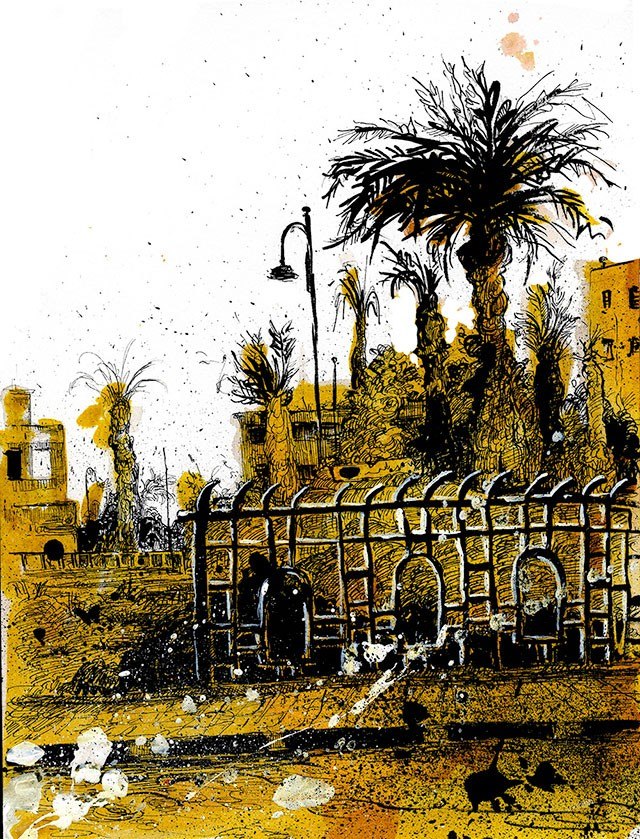
Vanity Fair published the story of an anonymous citizen of Raqqa, the de facto capital of the self-proclaimed caliphate. The witness recounts in their words what the daily life in this city has turned into. Molly Crabappaple illustrated the article based on pictures taken with a cell phone.

Na’eem Square in Raqqa - by Molly Crabapple

Na’eem in Arabic means “paradise,” but ISIS changed this beautiful public place into the complete opposite. The square that was a favorite place for boys and girls to have dates, for little kids to play, and for the elders to relive their youths by taking in the activity of the city, is now the awful place of spikes upon which chopped-off heads are placed. The story of this square sums up the dark story of the whole city.

The story and depictions align with what can be seen in the the Vice videos that were released in August and September – these are the only independent video documents that have been published since ISIS asserted power over eastern Syria. They are well worth watching as a first-hand account of what is happening and what is at stake in this region.

The Loma Prieta Earthquake 1989 + 2014 Mashup

Apart from being my birthday, tomorrow will also mark the 25th anniversary of the Loma Prieta earthquake, the Bay Area’s worst natural disaster since the great 1906 shake.

Shawn Clover created a page where he presents photographical mashups of the damages from the 1989 along with the same location in present day – the results are visually stunning. It is a testament to both the humbling forces of nature and the capability of human societies to tirelessly rebuild.

The article also presents in a succinct and rather terrifying way the blunt truth: what’s ahead of us is worse than Loma Prieta in every possible way – magnitude and duration. How are those emergency supplies going for you?

The Dipsea Trail

I went to hike the Dipsea Trail this past Sunday and it was amazing – it’s the kind of typical Bay Area thing I feel I should have done years ago but the occasion never presented itself before today. We drove to Stinson Beach in the morning to catch the bus to Mill Valley then hiked our way back over Mount Tamalpais. The path essentially ends by the beach, so we were in for a nice sunset by the ocean, in which we could also dip our toes and get rid of some of the dirt. I’m still having a hard time believing that people run this trail (much less twice or even four times in a row).

The vistas were simply breathtaking. I had had a pretty nice bike ride on the previous day exactly in the same area and I am generally speaking quite familiar with the roads in Marin County, but I was surprised how different it feels to walk the paths by the side of the road. I’m not much of a hiker – I can’t say this was an easy hike (the walk itself took about 4hrs) but there are plenty of places to stop and take pictures or just rest.

The variety of terrain helps to stay distracted and it’s easy to lose track of time. There was also plenty of wildlife around the path – deers, squirrels and a whole array of species of birds. My understanding is that this is one of the greatest trail in North California, yet there were remarkably few people on it, possibly due to the occurrence of Fleet Week that same week-end. I feel like this is the kind of perfect introduction to somewhat serious hiking, a bit like a gateway drug. At $2 for the bus ride, this is one hella cheap habit to get into.

Your Startup is Broken

If you’re not already familiar with the works of Shanley, then the release of her latest book is probably a good and comprehensive way to get a feel for it.

Your Startup is Broken is a set of essays that each attempt to deconstruct and criticize the organizational and social flaws of companies in the tech industry and specifically the smaller ones.

The first 100 pages are essentially trying to address issues that are common to most companies, but that the typical startup environment – scruffy, fast, monocultural – tends to either exacerbate or ignore. The meat of the book is the section that gathers essays around the topic of misogyny and sexism – something that permeates our entire society but whose manifestation in the industry is highly visible.

If you’re already familiar with those problematics, the book is probably not going to be an eye-opener. If you’re not, then you might be in for a rough ride. The words can be harsh but what’s harsher is the ring of truth behind them:

And then there is Lean In, the new brand of white, extreme upper-class tech feminism championed by Sheryl Sandberg and epitomized by Marissa Mayer. It is a self-interested feminism of white privilege, bereft of historical context, bereft of critical thought. It is a feminism removed utterly from the challenges of average women workers in tech, a feminism deliberately pacified for the devouring palate of the status quo.

It is, at last, a feminism the patriarchy can get behind.

Certain articles definitely exposed patterns in a way that I hadn’t picked upon before, or shed light onto something I ignored because of my own history. Regardless of your own perspective and opinions, the book certainly offers a whole lot of food for thought, which is well worth $10.